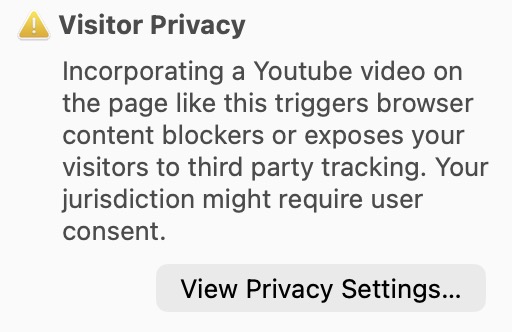
"Visitor Privacy"

I’ve watched videos on various webpages and forums since the last century and hope to understand this:

There was a forum which cleverly blocked ads inside the vids, but Youtube partly slipped through some vids. Does this setting achieve something like that without incuring lawful risks? (I’m not opposed to the ad marketing which pays for the hosting of vids).

Ad blocking on platforms like YouTube can only really work on the ads that YouTube insert to appear during the runtime of the video - it can’t block any in-video ads that are placed into the actual video as part of the produced content. This is why some YouTube videos will be labelled with something like “includes paid promotion”

In the context of Sitely, if you don’t have a privacy option set up, you could be in breach of regulations in certain countries, but also, the lack of any privacy protection will allow any third-party website linked to yours to plant cookies on the visitors computer that could allow targeted advertising to be served by those third-party websites. Adding privacy protection won’t actually block things like YouTube ads from appearing, it just won’t be able to use information gathered from the user’s system to only display ads that may be of interest to site visitors based on their browsing history or other information.

The best option is to always enable privacy protection, particularly if you’re likely to be using third party content or services on your site. Site visitors then have the option of allowing cookies or not when the privacy banner is displayed. Additionally, any content served up by a third-party website will normally require specific consent before being displayed on the page.

1 Like

Thanks Stephie, for reply.

That would pertain to commercial, corporate, secular, professional or institutional legalisms. Harmlessly free expression outside of those domains should not insert unnecessary distractions to a privately made and owned Youtube video.

Your explanations would seem appropriate for the Sitely documentation, and yet there are also noble causes in the world which need not forcibly collect visitor data, and therefore this free, discreet publisher option also deserves a clear mention or procedure, for a Sitely user to follow, and to share their own Youtube link without impeding the site visitor.

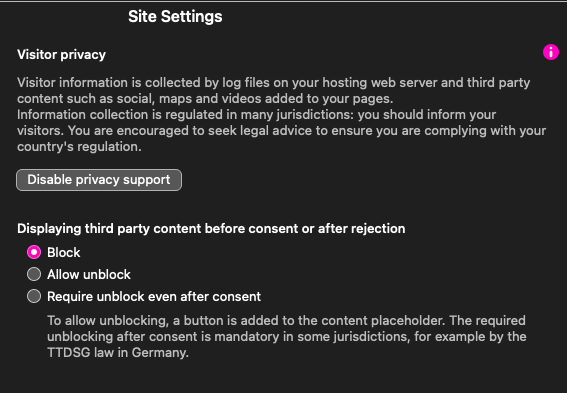
After I clicked that Site Setting box, it filled my test page with legalisms of no interest whatsoever, but there was no immediately-apparent way to remove the large overlay, nor contain it in some sort of discrete “Policy Button”, nor was it possible to undo the invocation. Luckily it was a test page, to avoid affecting my website.

Your kindly shared sitely-freedom-to-design.pdf listed 2 pages with the word ‘Youtube’, and 15 pages using the word ‘video’. Sitely’s docs also briefly mention these. However there appear no “Quick Startup” procedures of adding a video, such as forums offer or social platforms offer. This level of use is common-place on the public www, (and deserve Sitely-doc exemplification).

The “Not Secure” website declaration is another, separate matter involving money or time investments, and it has not been prioritized by lifelong seekers of wisdom traditions, (unless and until the extensive content priorities are completed first).

….

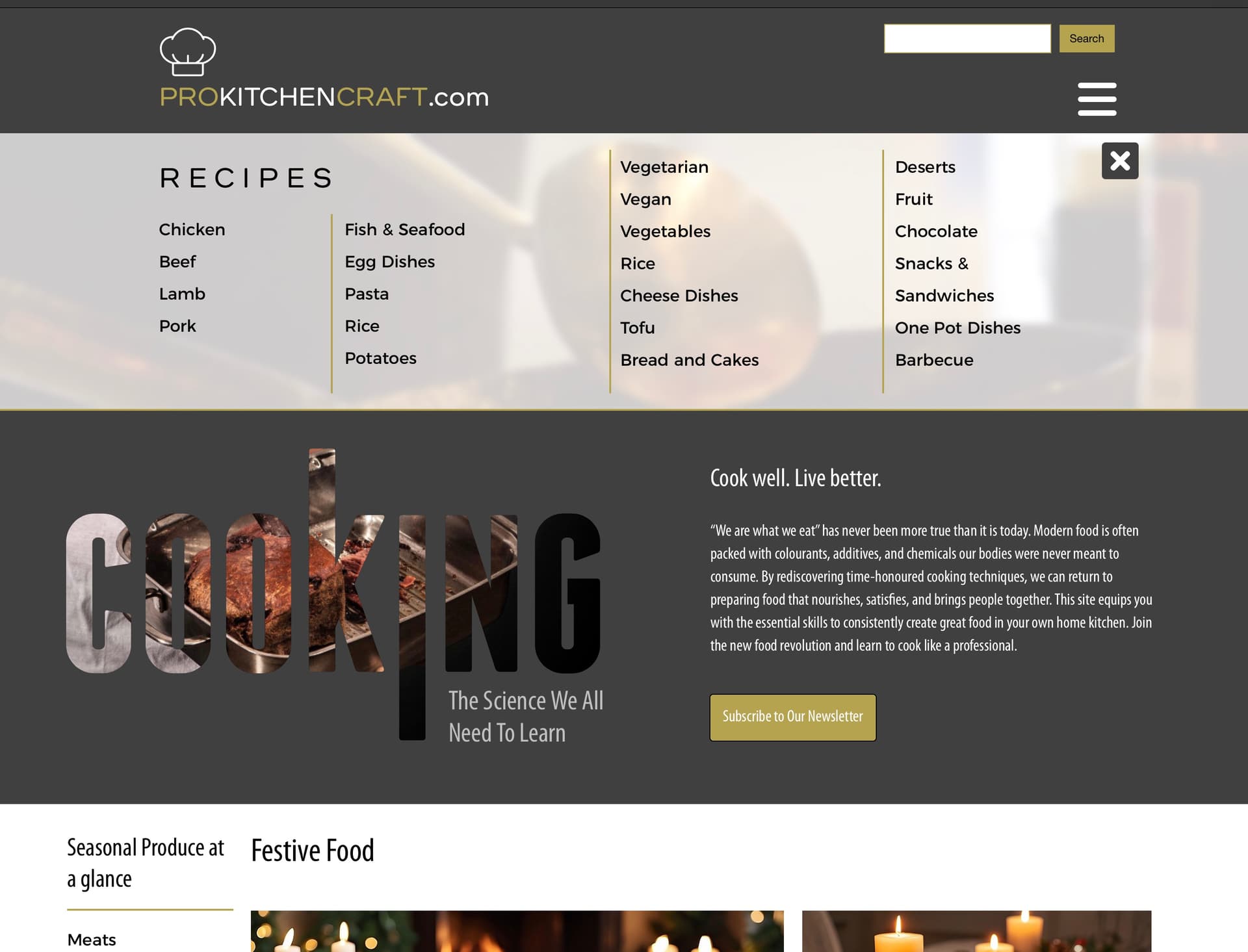
Soon, a mega-menu will be prioritized here, but a very sparse procedural description is found on line for Sitely, and a simple example is not mentioned. Is there something problematic with a huge, plain popup which could accommodate a growing list of links begun as plain text, and with links added next? Wouldn’t that expediently-satisfy a functional mega-menu ?

Understandably the nicely offered vendor-menu-examples deserve the space given in documentation, but does not the plain text style of menu deserve mention in case we should be advised about some unknown surprise issue which results later?

~Bo
1 Like

A text-only mega menu isn’t a problem in Sitely - I use them all the time. In the example below, you can see a mega menu created as popup, but it could equally be created in a layout block which will require you to use the visibility function on the main menu link to display it. In either case, expanding the menu later to include additional links wont cause you any issues - just increase the size of the popup or layout block and add the extra text links.

hi @boatkinson,

privacy laws don’t distinguish who is exposing people to tracking, it’s irrelevant. In many jurisdictions, it’s illegal to expose site visitors to tracking without their consent. This includes embedding youtube videos, Google Maps, instagram images, to name a few, in the page. If you merely link to a youtube video for example, by means of an “On click” action with an external link pointing to the youtube video, that is technically unable to collect information so there’s no regulation around that.

I get that this is confusing, but I do believe the user interface does tell you that what you are doing might not be acceptable from a privacy point of view:

This should be enough for you to know to not do that, if you don’t want to get involved with privacy matters.

It’s not like the documentation can frontload all information all at once. Though of course there certainly is no end to how much anything can be improved, we are aware.

By the way the addition of a privacy page can be undone via the usual Edit → Undo, or after the fact by deactivating the privacy feature, followed by deletion of the privacy page.

3 Likes